••
← Back to Blog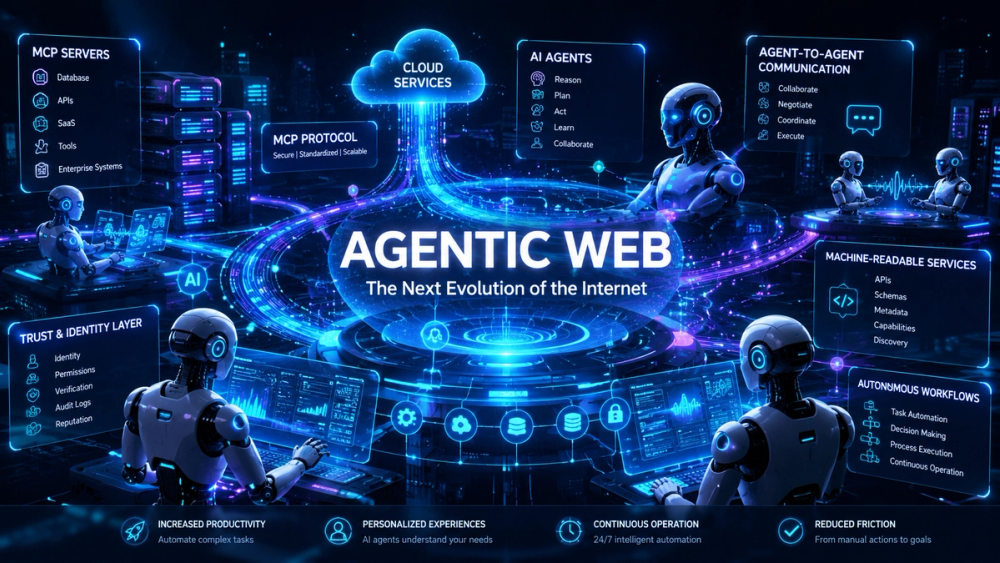
AI & Web Technology
Artificial Intelligence
Agentic Web: The Next Evolution of the Internet
Jun 12, 2026, 09:58 AM•5 min read• Aditya Sahrawat
Aditya SahrawatAgentic Web: The Next Evolution of the Internet
The internet has evolved dramatically over the past three decades.
Web 1.0 allowed users to consume information.
Web 2.0 introduced social interaction and user-generated content.
Web 3.0 focused on decentralization, ownership, and blockchain technologies.
Now, a new paradigm is emerging: The Agentic Web.
Instead of humans manually navigating websites, searching for information, and completing tasks, AI agents will increasingly perform these actions autonomously. The Agentic Web represents a future where intelligent agents become active participants in the digital ecosystem, capable of making decisions, interacting with services, and completing complex workflows on behalf of users.
This shift could fundamentally change how we interact with the internet.
What Is the Agentic Web?
The Agentic Web is an internet ecosystem designed for autonomous AI agents rather than solely human users.
These agents can:
- Search and gather information
- Compare products and services
- Execute workflows
- Manage business operations
- Communicate with other agents
- Access tools and APIs
- Make context-aware decisions
Rather than opening multiple browser tabs and manually completing tasks, users can delegate objectives to AI systems that navigate the web independently.
For example:
Instead of searching flights, comparing prices, booking hotels, and planning transportation yourself, an AI travel agent could complete the entire process according to your preferences and budget.
The user provides goals.
The agent handles execution.
Why the Current Web Isn't Built for Agents
Today's web was primarily designed for humans.
Most websites expect:
- Mouse clicks
- Keyboard input
- Visual interactions
- Human interpretation
AI agents often need to rely on:
- Browser automation
- Screen scraping
- Complex workflows
- Fragile integrations
This approach introduces inefficiencies and reliability issues.
The Agentic Web aims to solve these challenges by creating standardized ways for agents to discover services, communicate with systems, and execute actions securely.
Core Components of the Agentic Web
1. AI Agents
AI agents serve as autonomous digital workers capable of reasoning, planning, and acting.
Modern agents can:
- Understand goals
- Break objectives into tasks
- Select tools
- Execute actions
- Evaluate outcomes
As large language models improve, agents are becoming increasingly capable of handling sophisticated workflows with minimal human intervention.
2. MCP Servers
One of the most important technologies enabling the Agentic Web is the Model Context Protocol (MCP).
MCP servers provide standardized access to:
- Databases
- APIs
- SaaS platforms
- Internal tools
- Enterprise systems
Instead of building custom integrations for every service, agents can connect through MCP-compatible interfaces.
This creates a common language between AI systems and external tools.
3. Agent-to-Agent Communication
Future internet services may involve multiple agents collaborating together.
Examples include:
- A sales agent negotiating with a procurement agent
- A travel agent coordinating with transportation agents
- Customer support agents interacting with technical support agents
This creates entirely new digital ecosystems where autonomous systems cooperate to achieve goals.
4. Machine-Readable Services
Today's websites are optimized for people.
The Agentic Web requires services optimized for machines.
This includes:
- Structured APIs
- Semantic metadata
- Tool definitions
- Capability discovery
- Authentication standards
Services will expose functionality that agents can understand and use directly.
5. Trust and Identity Layers
If AI agents can make purchases, access data, and perform actions, trust becomes essential.
Future systems will require:
- Agent identities
- Permission controls
- Audit logs
- Verification mechanisms
- Reputation systems
Organizations will need clear visibility into what agents are doing and why.
Real-World Use Cases
Autonomous Business Operations
Businesses could deploy specialized agents for:
- Customer support
- Marketing campaigns
- Lead generation
- Security monitoring
- Infrastructure management
These agents could operate continuously with minimal supervision.
Software Development
AI development agents may:
- Write code
- Review pull requests
- Fix vulnerabilities
- Deploy applications
- Monitor production systems
Developers become supervisors rather than manual executors.
E-Commerce
Shopping agents can:
- Compare products
- Negotiate prices
- Track discounts
- Place orders
- Manage subscriptions
Consumers may rarely visit traditional online stores directly.
Healthcare
Healthcare agents could:
- Schedule appointments
- Monitor patient data
- Coordinate care
- Analyze records
- Provide personalized recommendations
Human professionals remain responsible for oversight while agents handle routine workflows.
Benefits of the Agentic Web
Increased Productivity
Tasks that currently require hours of manual effort can be completed automatically.
Personalized Experiences
Agents understand user preferences and adapt decisions accordingly.
Continuous Operation
Unlike humans, AI agents can work 24/7.
Reduced Friction
Complex workflows become simplified into high-level objectives.
Instead of learning software, users simply communicate goals.
Challenges and Risks
The Agentic Web also introduces significant concerns.
Security Risks
Compromised agents could gain access to sensitive systems or data.
Organizations must implement robust security controls.
Privacy Concerns
Agents often require access to personal information to operate effectively.
Protecting this data is critical.
Agent Misalignment
Agents may misunderstand objectives and execute unintended actions.
Human oversight remains necessary.
Regulatory Questions
Governments and organizations must define rules around:
- Agent accountability
- Digital identity
- Automated transactions
- Liability
These frameworks are still evolving.
How Businesses Should Prepare
Organizations should begin preparing now.
Recommended steps include:
- Build API-first architectures.
- Explore MCP-compatible tooling.
- Invest in AI automation workflows.
- Strengthen cybersecurity practices.
- Create governance policies for AI agents.
- Develop machine-readable services.
Companies that adapt early may gain significant competitive advantages as autonomous systems become mainstream.
The Future of the Internet
The transition to the Agentic Web may be as significant as the rise of mobile devices or cloud computing.
In the coming years, users may spend less time interacting directly with websites and more time delegating tasks to intelligent agents.
The internet will no longer be a network of pages designed exclusively for humans.
It will become a network of services, tools, and autonomous agents collaborating to achieve outcomes.
Organizations building for this future today will be positioned at the forefront of the next major technological revolution.