••
← Back to Blog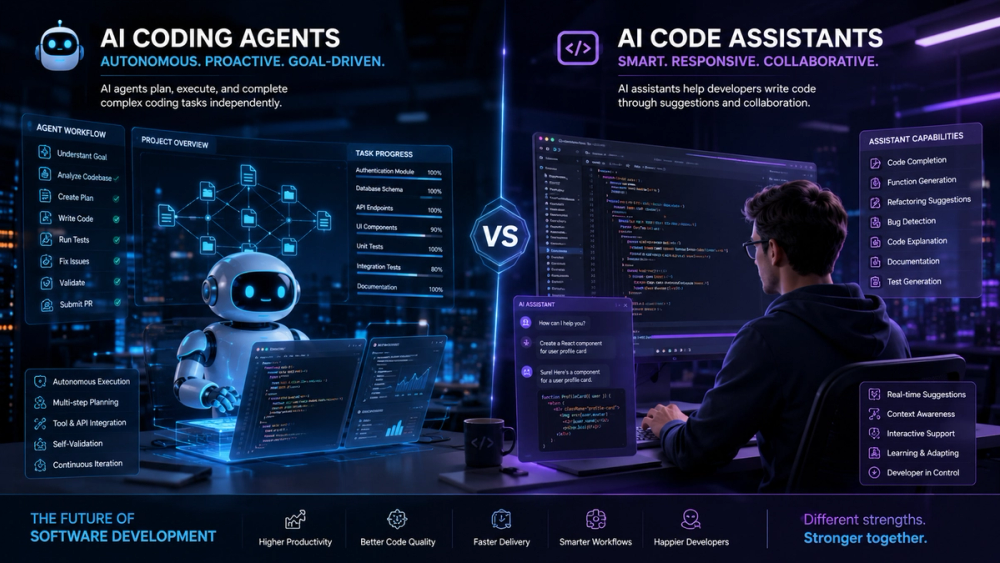
Artificial Intelligence
AI Coding Agents vs AI Code Assistants: What's the Difference in 2026?
Jun 14, 2026, 03:11 PM•6 min read• Aditya Sahrawat
Aditya SahrawatAI Coding Agents vs AI Code Assistants: What's the Difference in 2026?
Artificial intelligence has become a core part of modern software development. Nearly every developer now uses some form of AI assistance to write code, debug applications, generate documentation, or accelerate workflows.
However, a major shift emerged in 2025 and accelerated throughout 2026: the rise of AI Coding Agents.
Many teams still use the terms AI coding agent and AI code assistant interchangeably, but they represent fundamentally different approaches to software development.
Understanding this distinction is becoming increasingly important as organizations evaluate the next generation of AI-powered developer tools.
In this article, we'll explore what AI coding agents are, how they differ from traditional AI code assistants, and where each technology fits in modern engineering teams.
What Is an AI Code Assistant?
An AI code assistant is a tool that helps developers perform coding tasks through direct interaction.
The assistant responds to prompts, suggestions, or commands provided by the developer. While highly capable, it generally operates under continuous human supervision.
Common capabilities include:
- Code completion
- Function generation
- Refactoring suggestions
- Documentation creation
- Unit test generation
- Debugging assistance
- Code explanation
The developer remains in control of every step.
Typical workflow:
- Developer writes code.
- Assistant suggests improvements.
- Developer reviews output.
- Developer decides what to accept.
The AI acts as an intelligent collaborator rather than an autonomous worker.
Examples include:
- GitHub Copilot
- Cursor AI Chat
- Windsurf Cascade (assistant mode)
- JetBrains AI Assistant
- Amazon Q Developer
These tools significantly improve productivity but still require active guidance.
What Is an AI Coding Agent?
An AI coding agent goes beyond assistance.
Instead of simply responding to prompts, it can independently execute multi-step software development tasks.
A coding agent typically:
- Understands a goal
- Creates a plan
- Executes actions
- Uses tools
- Reviews results
- Iterates until completion
Rather than asking:
"Generate a login page"
You can assign:
"Build authentication for this SaaS application using Next.js, PostgreSQL, and OAuth."
The agent may:
- Analyze the codebase
- Create implementation plans
- Generate backend code
- Update database schemas
- Create frontend components
- Write tests
- Run validation checks
- Fix discovered errors
- Submit a pull request
All with minimal intervention.
This represents a transition from AI assistance to AI delegation.
The Core Difference: Assistance vs Autonomy
The biggest distinction is autonomy.
Feature
AI Code Assistant
AI Coding Agent
Requires Human Guidance
Yes
Minimal
Executes Multiple Steps
Limited
Yes
Plans Work
No
Yes
Uses External Tools
Limited
Extensive
Runs Commands
Rarely
Frequently
Maintains Task Context
Short-term
Long-term
Handles Complex Projects
Partial
Strong
Operates Independently
No
Yes
Code assistants help developers write code.
Coding agents help developers complete projects.
How AI Code Assistants Work
Traditional AI assistants operate in a request-response pattern.
The workflow looks like:
Developer → Prompt → AI Response → Developer Review
For example:
Developer:
"Create a React component for a pricing table."
Assistant:
Generates component code.
Developer:
Reviews and modifies output.
The AI waits for the next instruction.
This model works exceptionally well for:
- Daily coding
- Learning
- Small feature development
- Refactoring
- Documentation
The human remains the project manager.
How AI Coding Agents Work
Coding agents introduce an autonomous execution loop.
Typical agent workflow:
Goal → Planning → Action → Validation → Iteration → Completion
For example:
Task:
"Implement Stripe subscription billing."
The agent may:
- Analyze repository structure.
- Identify existing billing code.
- Create implementation strategy.
- Generate backend endpoints.
- Update database models.
- Create UI components.
- Add tests.
- Run build checks.
- Fix failures.
- Submit completed changes.
The developer reviews results rather than managing every individual step.
Why Coding Agents Are Growing Rapidly in 2026
Several technological advancements made coding agents practical:
Larger Context Windows
Modern AI systems can process entire repositories instead of isolated files.
Agents understand:
- Architecture
- Dependencies
- Business logic
- Development history
This enables higher-quality decision making.
Tool Integration
Modern agents connect directly to:
- Git repositories
- Databases
- Browsers
- CI/CD pipelines
- Cloud infrastructure
- Documentation systems
They can act rather than simply suggest.
Persistent Memory
Agents increasingly maintain long-term context.
They remember:
- Previous tasks
- Coding standards
- Team preferences
- Project conventions
This improves consistency across large projects.
Better Reasoning Models
Reasoning-focused AI models now perform:
- Task decomposition
- Planning
- Error recovery
- Verification
These capabilities enable autonomous workflows previously impossible with traditional assistants.
When AI Code Assistants Are Better
Despite the excitement around agents, assistants remain valuable.
They are often superior when:
Learning New Technologies
Developers benefit from interactive explanations and guidance.
Sensitive Code Changes
Critical systems often require direct human involvement.
Quick Coding Tasks
Opening a full agent workflow may be unnecessary for simple changes.
Pair Programming
Assistants behave like intelligent collaborators.
For many developers, assistants remain the fastest option for everyday work.
When AI Coding Agents Are Better
Agents excel in larger and more complex workflows.
Examples include:
Feature Development
Implementing complete features from specifications.
Legacy Code Modernization
Analyzing large codebases and performing systematic upgrades.
Test Automation
Generating and maintaining comprehensive test suites.
Bug Investigation
Tracing issues across multiple systems and repositories.
Developer Operations
Managing deployment pipelines and infrastructure tasks.
These workflows often involve dozens or hundreds of coordinated actions.
Challenges of AI Coding Agents
While powerful, coding agents are not perfect.
Trust and Verification
Autonomous systems can make incorrect assumptions.
Human review remains essential.
Security Risks
Agents often access:
- Repositories
- Databases
- Cloud services
Organizations must establish strong permission controls.
Cost
Long-running autonomous workflows consume significantly more compute resources than simple assistant interactions.
Context Accuracy
Large projects still present challenges.
An agent can occasionally misunderstand architectural decisions or business requirements.
The Future: Hybrid Development Teams
The future is unlikely to be agents replacing assistants.
Instead, organizations are adopting hybrid workflows.
Developers use:
AI Assistants For
- Daily coding
- Brainstorming
- Learning
- Refactoring
- Documentation
AI Agents For
- Large features
- Maintenance tasks
- Testing
- Repository-wide updates
- Automation workflows
This combination maximizes productivity while preserving human oversight.
What This Means for Developers
Developers are evolving from pure code writers into AI supervisors and system architects.
Key skills in 2026 include:
- Defining requirements clearly
- Reviewing AI-generated code
- Designing system architecture
- Managing autonomous workflows
- Evaluating security and quality
The most productive engineers are no longer those who type the fastest.
They are the ones who effectively coordinate human expertise with AI capabilities.
Final Thoughts
The difference between AI coding agents and AI code assistants comes down to one word: autonomy.
AI code assistants help developers write code by responding to prompts and suggestions. AI coding agents take a goal, create a plan, execute tasks, and work toward completion with far less human involvement.
As AI continues to evolve, both technologies will play critical roles in software development. Assistants will remain indispensable for interactive coding, while agents will increasingly handle complex, multi-step engineering tasks.
The organizations that learn to combine both approaches effectively will gain the greatest productivity advantages in the next era of software development.