••
← Back to Blog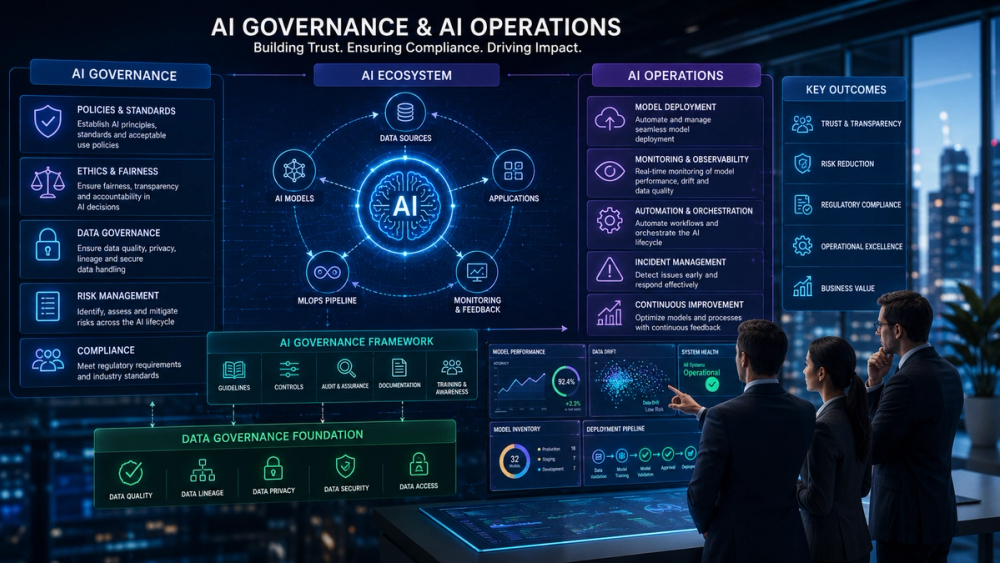
Artificial Intelligence
Cyber Security
AI Governance & AI Operations: Building Trust, Compliance, and Scalability in Enterprise AI
Jun 16, 2026, 03:33 PM•4 min read• Aditya Sahrawat
Aditya SahrawatAI Governance & AI Operations: Building Responsible and Scalable AI Systems
Artificial Intelligence is transforming industries at an unprecedented pace. Organizations are rapidly integrating AI into customer service, decision-making, operations, cybersecurity, healthcare, and finance. However, as AI adoption accelerates, businesses face growing challenges related to compliance, transparency, security, and operational reliability.
This is where AI Governance and AI Operations (AIOps/MLOps) become critical. While AI Governance focuses on establishing policies, accountability, and ethical standards, AI Operations ensures that AI models perform efficiently, reliably, and securely in production environments.
Together, they form the backbone of responsible and scalable enterprise AI.
What is AI Governance?
AI Governance refers to the framework of policies, processes, controls, and standards that guide the development, deployment, and use of AI systems.
Its primary objectives include:
- Ensuring regulatory compliance
- Managing AI-related risks
- Promoting transparency and explainability
- Preventing bias and discrimination
- Protecting privacy and security
- Establishing accountability for AI decisions
Organizations implementing AI Governance create clear guidelines that align AI initiatives with business goals, ethical principles, and legal requirements.
Core Components of AI Governance
1. Risk Management
Identifying and mitigating risks associated with AI models, including bias, model drift, cybersecurity threats, and regulatory violations.
2. Compliance & Regulations
Ensuring adherence to evolving AI regulations, industry standards, and data protection laws.
3. Ethical AI Frameworks
Promoting fairness, accountability, transparency, and responsible AI usage.
4. Data Governance
Managing data quality, lineage, ownership, privacy, and access controls.
5. Model Transparency
Providing explainability and auditability for AI-driven decisions.
What is AI Operations?
AI Operations encompasses the processes, tools, and practices required to deploy, monitor, manage, and optimize AI systems throughout their lifecycle.
AI Operations extends beyond model development and focuses on ensuring AI solutions remain effective in real-world environments.
Key Functions of AI Operations
Model Deployment
Automating deployment pipelines for machine learning and generative AI applications.
Performance Monitoring
Tracking model accuracy, latency, availability, and resource utilization.
Model Drift Detection
Identifying changes in data patterns that can impact model performance.
Incident Management
Resolving AI failures, anomalies, and operational disruptions quickly.
Continuous Improvement
Retraining and optimizing models using updated datasets and feedback loops.
AI Governance vs AI Operations
AI Governance
AI Operations
Defines policies and standards
Executes and manages AI systems
Focuses on compliance and ethics
Focuses on performance and reliability
Addresses risk management
Addresses operational efficiency
Establishes accountability
Ensures system availability
Guides decision-making
Supports continuous optimization
Although distinct, both disciplines are interconnected and must work together to achieve successful AI adoption.
Why Organizations Need Both
Many organizations focus heavily on model development while overlooking governance and operational management. This often leads to:
- Regulatory compliance issues
- Security vulnerabilities
- AI bias and fairness concerns
- Model performance degradation
- Increased operational costs
- Loss of stakeholder trust
By integrating governance and operations, organizations gain:
Improved Trust
Transparent AI systems increase confidence among customers, employees, and regulators.
Regulatory Readiness
Organizations can proactively adapt to emerging AI regulations.
Better Performance
Continuous monitoring ensures models remain accurate and efficient.
Reduced Risk
Governance frameworks help identify and mitigate risks before they impact business operations.
Scalability
Standardized processes enable faster deployment of AI across multiple business units.
Best Practices for Implementing AI Governance & Operations
Establish an AI Governance Board
Create a cross-functional team responsible for oversight, policy development, and risk management.
Define AI Lifecycle Controls
Implement governance checkpoints throughout development, deployment, monitoring, and retirement stages.
Automate Monitoring
Use observability platforms to track model health, bias, performance, and compliance metrics.
Maintain Documentation
Document datasets, model decisions, approvals, and audit trails for transparency.
Adopt Responsible AI Principles
Embed fairness, explainability, privacy, and accountability into AI workflows.
Integrate Governance with MLOps
Combine governance controls with deployment and monitoring pipelines to create a unified AI management framework.
Future of AI Governance & AI Operations
As generative AI, autonomous agents, and foundation models become more widespread, the need for robust governance and operational frameworks will continue to grow.
Future trends include:
- AI-specific regulatory frameworks
- Automated compliance monitoring
- Explainable AI platforms
- AI observability solutions
- Governance automation
- Real-time risk assessment
- Enterprise-wide AI control planes
Organizations that invest in both governance and operations today will be better positioned to scale AI responsibly while maintaining trust, security, and compliance.
Conclusion
AI Governance and AI Operations are no longer optional components of enterprise AI strategies. Governance ensures that AI is used responsibly, ethically, and compliantly, while Operations ensures that AI systems remain reliable, scalable, and effective.
Together, they create a comprehensive framework that enables organizations to unlock AI's full potential while minimizing risks and maximizing business value.