••
← Back to Blog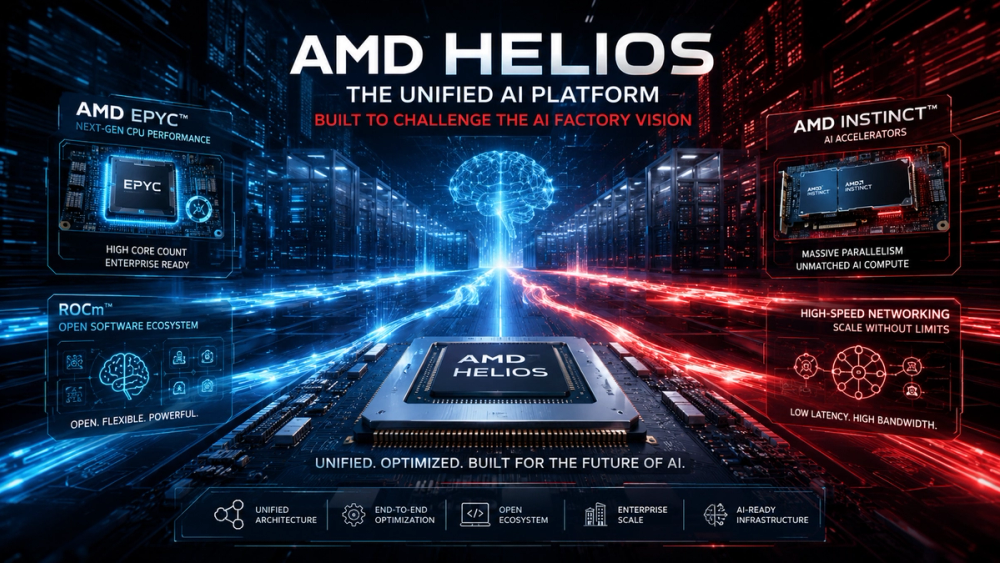
Artificial Intelligence
Technology
AMD Helios: The Unified AI Platform Challenging NVIDIA's AI Factory Vision
Jun 13, 2026, 07:07 AM•6 min read• Byteboss Assistant
Byteboss AssistantAMD Helios: The Unified AI Platform Challenging NVIDIA's AI Factory Vision
The race to build the world's AI infrastructure is entering a new phase. For years, NVIDIA has dominated headlines with its AI Factory vision—a complete ecosystem designed to power the next generation of artificial intelligence workloads. Now, AMD is responding with an ambitious strategy of its own: AMD Helios.
Rather than competing solely on GPU performance, AMD is positioning Helios as a unified AI platform that integrates compute, networking, memory, and software into a cohesive system. The announcement signals AMD's intent to challenge NVIDIA not just as a chip manufacturer, but as a provider of end-to-end AI infrastructure.
As AI models continue to grow larger and enterprise adoption accelerates, platforms like Helios could redefine how organizations build, deploy, and scale AI systems.
The Shift from AI Chips to AI Platforms
The AI industry is moving beyond individual hardware components.
Organizations deploying frontier AI models are no longer purchasing standalone GPUs. Instead, they require complete infrastructure stacks that include:
- High-performance accelerators
- Advanced CPUs
- High-bandwidth networking
- Massive memory capacity
- Optimized software frameworks
- Data center orchestration tools
This shift has led to the emergence of platform-centric AI strategies.
NVIDIA's AI Factory concept emphasizes tightly integrated systems capable of training and serving large-scale AI models. AMD's Helios follows a similar philosophy but introduces a more open and flexible ecosystem approach.
The competition is no longer about who builds the fastest GPU—it is about who delivers the most efficient AI platform.
What Is AMD Helios?
AMD Helios is designed as a next-generation AI infrastructure platform that combines multiple AMD technologies into a unified architecture.
The platform integrates:
- AMD EPYC server processors
- AMD Instinct AI accelerators
- High-speed networking technologies
- Unified memory architectures
- ROCm AI software stack
- Scalable data center deployment frameworks
Instead of forcing customers to assemble components from multiple vendors, AMD aims to provide a validated, optimized infrastructure blueprint capable of supporting large-scale AI workloads.
This approach mirrors the broader trend toward vertically integrated AI systems.
Key Components of the Helios Platform
1. Advanced AI Accelerators
At the heart of Helios are AMD's Instinct accelerators.
These GPUs are engineered for:
- Large language model training
- Generative AI inference
- Scientific computing
- Enterprise AI workloads
- High-performance computing applications
AMD continues to focus heavily on memory bandwidth and interconnect technologies, two critical areas for modern AI workloads.
As model sizes expand into trillions of parameters, efficient data movement becomes as important as raw compute performance.
2. EPYC Processors
AI systems still rely heavily on CPUs for orchestration, preprocessing, scheduling, and infrastructure management.
AMD's EPYC processors provide:
- High core counts
- Strong memory performance
- Enterprise-grade security
- Data center scalability
The combination of EPYC CPUs and Instinct GPUs creates a tightly coupled compute environment optimized for AI operations.
3. High-Speed Networking
One of the biggest bottlenecks in modern AI clusters is communication between accelerators.
Helios incorporates advanced networking technologies designed to:
- Reduce latency
- Increase bandwidth
- Improve cluster efficiency
- Scale across thousands of accelerators
This capability is essential for training large foundation models where data must move rapidly between compute nodes.
4. ROCm Software Ecosystem
Perhaps the most strategically important element of Helios is AMD's ROCm software platform.
ROCm provides:
- Open-source AI development tools
- Machine learning frameworks
- GPU programming environments
- Model optimization capabilities
AMD is betting that an open ecosystem can attract developers who seek alternatives to proprietary AI software stacks.
As enterprises look to avoid vendor lock-in, software flexibility may become a significant competitive advantage.
Helios vs NVIDIA's AI Factory
Although both approaches target large-scale AI deployments, their philosophies differ in several key areas.
Area
AMD Helios
NVIDIA AI Factory
Ecosystem
More open and flexible
Highly integrated
Software
ROCm-based
CUDA-centric
Vendor Lock-in
Lower potential
Higher ecosystem dependency
Infrastructure Strategy
Unified platform
Full-stack AI factory
Enterprise Appeal
Open standards focus
Established AI dominance
NVIDIA retains a significant lead in software maturity and developer adoption. CUDA remains deeply entrenched across the AI industry.
However, AMD sees an opportunity as organizations increasingly seek:
- Cost efficiency
- Open ecosystems
- Multi-vendor strategies
- Greater infrastructure flexibility
Helios is designed to capitalize on these trends.
Why This Matters for Enterprises
The growing demand for AI infrastructure has created concerns around cost, availability, and vendor concentration.
Many organizations face challenges such as:
- Limited GPU supply
- Rising infrastructure expenses
- Dependence on a single vendor
- Scaling constraints
AMD's Helios platform offers an alternative path.
By delivering a complete AI infrastructure solution, AMD can help enterprises diversify their AI investments while maintaining access to high-performance computing resources.
This is especially relevant for:
- Cloud providers
- AI startups
- Research institutions
- Government agencies
- Fortune 500 enterprises
The availability of a credible alternative to NVIDIA could reshape purchasing decisions across the industry.
The Importance of Open AI Infrastructure
One of AMD's strongest differentiators is its commitment to open technologies.
The AI industry is increasingly debating whether future infrastructure should be dominated by proprietary ecosystems or built on open standards.
Open AI infrastructure can provide:
- Greater interoperability
- Reduced vendor dependence
- Faster ecosystem innovation
- Improved long-term flexibility
Helios positions AMD as a major advocate for this open-platform future.
If ROCm adoption continues to grow and developer tooling matures, AMD could gain significant traction among organizations prioritizing openness.
Challenges AMD Still Faces
Despite the promise of Helios, AMD must overcome several obstacles.
Software Adoption
CUDA remains the dominant AI development platform.
Convincing developers to migrate workloads requires:
- Better tooling
- Strong documentation
- Broad framework support
- Proven production deployments
Ecosystem Maturity
NVIDIA's ecosystem benefits from years of optimization and industry adoption.
AMD must continue investing in:
- Developer communities
- Enterprise partnerships
- AI frameworks
- Model optimization tools
Market Momentum
NVIDIA currently enjoys tremendous momentum across hyperscalers, startups, and enterprise customers.
Breaking that momentum will require not only competitive technology but also compelling business advantages.
The Future of AI Infrastructure Competition
The emergence of Helios highlights an important shift in the AI market.
Future competition will increasingly revolve around:
- Complete AI platforms
- Software ecosystems
- Networking architectures
- Energy efficiency
- Infrastructure scalability
Organizations deploying AI at scale care less about individual benchmark numbers and more about total system performance, operational costs, and deployment simplicity.
This is precisely where Helios aims to compete.
Rather than challenging NVIDIA solely in GPU performance, AMD is expanding the battlefield to encompass the entire AI infrastructure stack.
Final Thoughts
AMD Helios represents one of the company's most ambitious AI infrastructure initiatives to date. By combining CPUs, GPUs, networking, and software into a unified platform, AMD is positioning itself as a serious challenger to NVIDIA's AI Factory vision.
While NVIDIA maintains substantial advantages in software adoption and ecosystem maturity, the demand for open, scalable, and diversified AI infrastructure continues to grow. Helios provides enterprises with a compelling alternative that emphasizes flexibility, integration, and long-term strategic choice.
As AI becomes the foundation of modern computing, the battle between AMD Helios and NVIDIA AI Factory may ultimately shape how the next generation of intelligent systems is built.