••
← Back to Blog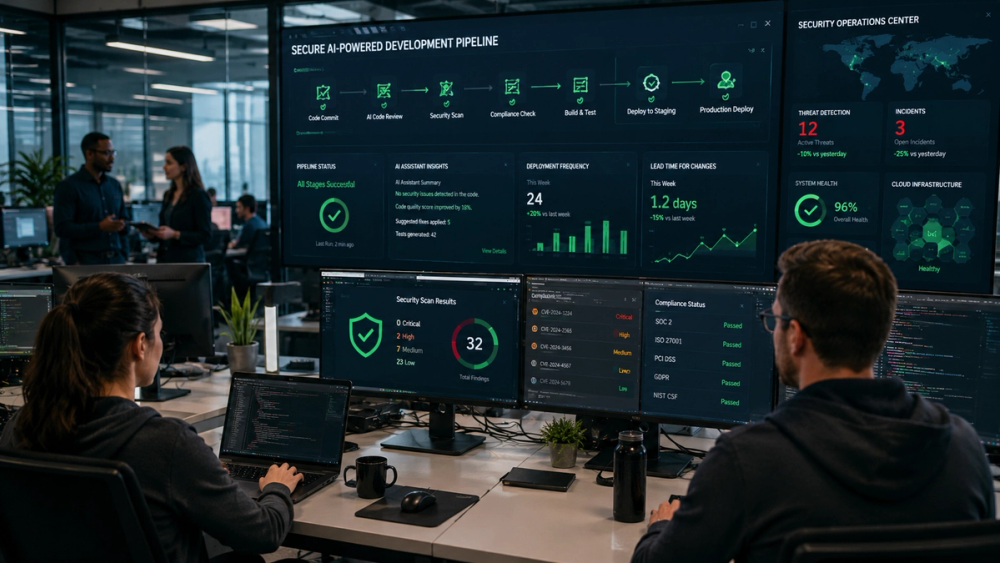
Artificial Intelligence
Technology
Building Secure AI-Powered Development Pipelines
Jun 18, 2026, 09:15 PM•5 min read• Aditya Sahrawat
Aditya SahrawatBuilding Secure AI-Powered Development Pipelines
Introduction
AI-powered development tools have rapidly become part of modern software engineering.
From code generation and automated testing to pull request reviews and infrastructure provisioning, AI is helping teams ship software faster than ever before.
However, speed without security creates risk.
As organizations increasingly adopt AI coding assistants and autonomous development workflows, they face new challenges:
- AI-generated vulnerabilities
- Prompt injection attacks
- Dependency supply chain risks
- Data leakage through AI models
- Compliance and governance concerns
- Unauthorized code generation
The future of software engineering isn't just AI-powered.
It's secure AI-powered development.
Let's explore how engineering teams can build resilient AI-enabled pipelines without sacrificing velocity.
Why Traditional DevSecOps Is No Longer Enough
Traditional DevSecOps focuses on:
- Static Application Security Testing (SAST)
- Dynamic Application Security Testing (DAST)
- Dependency scanning
- Infrastructure security
- CI/CD protection
While these controls remain critical, AI introduces entirely new attack surfaces.
New AI-Specific Risks
Risk
Impact
Prompt Injection
Manipulated AI outputs
Sensitive Data Leakage
Exposure of proprietary information
Hallucinated Code
Vulnerable implementations
Malicious Dependencies
Supply chain compromise
Model Poisoning
Corrupted AI recommendations
Unauthorized AI Usage
Compliance violations
Security teams must now protect both software and AI systems simultaneously.
Architecture of a Secure AI Development Pipeline
A modern AI-powered pipeline should include multiple security layers.
Developer
↓
AI Coding Assistant
↓
Policy Validation Layer
↓
Security Scanning
↓
Dependency Verification
↓
Automated Testing
↓
AI Code Review
↓
CI/CD Security Controls
↓
Production Deployment
↓
Continuous Monitoring
Every stage should include automated validation and governance.
Layer 1: Secure AI Code Generation
AI coding assistants can significantly accelerate development.
However, generated code should never be blindly trusted.
Best Practices
✅ Restrict AI access to sensitive repositories
✅ Use approved enterprise AI models
✅ Implement prompt filtering
✅ Scan generated code before commit
✅ Enforce coding standards automatically
Example Workflow
Developer Prompt ↓AI Generates Code ↓Security Linter ↓SAST Scan ↓Policy Validation ↓Code Review
This ensures vulnerabilities are detected before entering the codebase.
Layer 2: AI-Aware Code Reviews
AI can improve pull request reviews by identifying:
- Security vulnerabilities
- Logic flaws
- Performance bottlenecks
- Compliance violations
- Secret exposure
Combining Human + AI Review
The strongest model is not:
❌ Human Only
❌ AI Only
Instead:
✅ Human + AI Collaboration
AI identifies patterns at scale while engineers provide contextual judgment.
This hybrid approach significantly improves code quality and reduces review fatigue.
Layer 3: Supply Chain Security
Software supply chain attacks continue to rise.
When AI generates code, it may recommend:
- Outdated packages
- Vulnerable dependencies
- Unmaintained libraries
Security Controls
Use automated tooling to verify:
- Package reputation
- CVE exposure
- License compliance
- Dependency age
- Maintenance activity
Implement:
npm auditsnyk testtrivy fs .
before every deployment.
Organizations should adopt Software Bill of Materials (SBOM) generation for complete dependency visibility.
Layer 4: Policy as Code
Security policies should be automated.
Manual reviews don't scale in AI-driven environments.
Examples
Prevent deployment if:
- High-severity vulnerabilities exist
- Secrets are detected
- Unauthorized AI tools are used
- Compliance requirements fail
- Security scans are skipped
Example:
deny: severity: critical action: block-deployment
Policy-as-Code creates consistent enforcement across teams.
Layer 5: Secure CI/CD Infrastructure
Your CI/CD platform becomes even more critical when AI is generating and modifying code.
Secure CI/CD Checklist
🔒 Short-lived credentials
🔒 OIDC authentication
🔒 Signed artifacts
🔒 Immutable build environments
🔒 Container image scanning
🔒 Branch protection rules
🔒 Least privilege permissions
🔒 Audit logging
A compromised pipeline can impact every application built within it.
Layer 6: AI Governance and Compliance
As regulations evolve, organizations need clear AI governance frameworks.
Key governance areas include:
Ownership
Who is responsible for AI-generated code?
Transparency
Can decisions be audited?
Accountability
Who approves AI-driven changes?
Monitoring
How is AI behavior evaluated over time?
Frameworks such as:
- NIST AI Risk Management Framework
- ISO 42001
- EU AI Act
are driving adoption of structured AI governance programs.
Organizations that establish governance early will scale AI more safely and efficiently.
Continuous Monitoring and Threat Detection
Security does not end after deployment.
AI-enabled systems require ongoing monitoring for:
- Model drift
- Security incidents
- Dependency vulnerabilities
- Runtime anomalies
- Infrastructure threats
Recommended Monitoring Stack
- SIEM Platforms
- Cloud Security Monitoring
- Vulnerability Management
- Runtime Application Protection
- AI Usage Analytics
The goal is continuous visibility across both software and AI systems.
Common Mistakes Teams Make
1. Trusting AI Output Blindly
AI-generated code should always be validated.
2. Ignoring Supply Chain Risks
Dependencies remain one of the largest attack vectors.
3. Skipping Governance
Security controls without governance create accountability gaps.
4. Over-Automating Security Decisions
Human oversight remains essential.
5. Treating AI as Just Another Tool
AI changes development workflows and requires dedicated controls.
The Future of Secure AI Engineering
The next generation of engineering organizations will operate with:
- AI coding assistants
- Autonomous testing agents
- AI-powered security reviews
- Policy-driven deployments
- Continuous governance
The competitive advantage won't come from adopting AI alone.
It will come from adopting AI securely.
Organizations that build security into their AI-powered pipelines today will be better positioned to innovate, scale, and comply with future regulations.
Key Takeaways
🎯 AI introduces new security challenges that traditional DevSecOps doesn't fully address.
🎯 Secure AI development requires governance, automation, and continuous monitoring.
🎯 AI-generated code should undergo the same security scrutiny as human-written code.
🎯 Supply chain security becomes even more critical in AI-assisted development.
🎯 Human oversight remains essential despite advances in autonomous engineering.
Call To Action
As AI becomes deeply integrated into software engineering, security can no longer be an afterthought.
How is your organization securing AI-generated code and AI-powered workflows today?
The teams that solve this challenge first will build faster—and safer—than everyone else.