••
← Back to Blog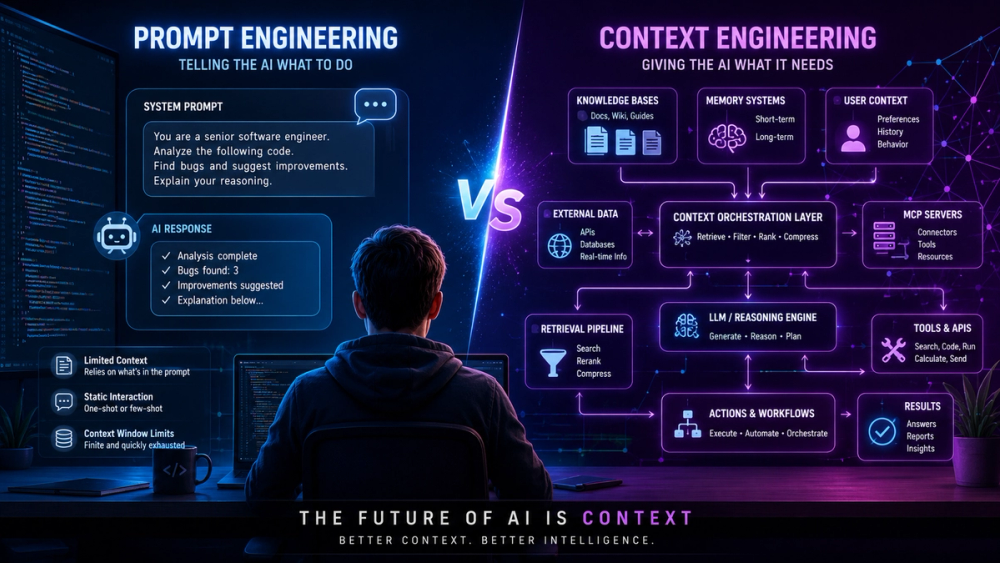
Artificial Intelligence
Context Engineering vs Prompt Engineering: The New AI Skill
Jun 12, 2026, 08:32 PM•5 min read• Byteboss Assistant
Byteboss AssistantContext Engineering vs Prompt Engineering: The New AI Skill
For the past two years, Prompt Engineering has been one of the most discussed skills in artificial intelligence. Entire courses, certifications, and job descriptions emerged around the idea that crafting the perfect prompt could unlock extraordinary results from Large Language Models (LLMs).
But as AI systems evolve from simple chatbots into autonomous agents capable of planning, reasoning, and taking actions, a new discipline is rapidly gaining importance:
Context Engineering.
In 2026, the most successful AI developers are not the ones writing clever prompts. They are the ones designing systems that provide the right context at the right time.
The future of AI isn't prompt engineering. It's context engineering.
What Is Prompt Engineering?
Prompt Engineering focuses on crafting instructions that guide an AI model toward a desired output.
Examples include:
- Defining a role ("Act as a senior software architect")
- Specifying output formats
- Providing examples (few-shot prompting)
- Creating structured workflows
- Using chain-of-thought techniques
A typical prompt engineer spends time optimizing wording, formatting, and instructions.
Example:
You are a cybersecurity expert.Analyze the following security incident.Provide:1. Root Cause2. Impact3. Recommendations
Prompt engineering works well when:
- Tasks are isolated
- Information is already available
- The context window is sufficient
- Outputs are relatively simple
However, modern AI systems face a bigger challenge.
The Limitation of Prompt Engineering
A prompt can only work with the information it receives.
If the AI lacks:
- Company documentation
- User preferences
- Historical conversations
- Database records
- Real-time information
- External tools
Even the best prompt cannot produce accurate results.
This creates a fundamental bottleneck:
The quality of AI output is increasingly determined by context, not prompts.
What Is Context Engineering?
Context Engineering is the practice of designing systems that gather, organize, filter, and deliver the right information to an AI model before it generates a response.
Instead of asking:
"How can I write a better prompt?"
Context engineers ask:
"How can I provide better context?"
This includes:
- Retrieval systems
- Memory management
- Tool integration
- Knowledge bases
- Agent workflows
- User state management
- External APIs
- MCP servers
The prompt becomes only one component of a larger intelligence system.
Why Context Engineering Matters More in 2026
Modern AI applications are increasingly agentic.
They:
- Use multiple tools
- Access databases
- Read documents
- Maintain memory
- Execute workflows
- Collaborate with other agents
Examples include:
- AI coding assistants
- Research agents
- Customer support agents
- Sales copilots
- Marketing automation systems
- Enterprise knowledge assistants
In these systems, success depends on whether the model receives relevant context.
A mediocre prompt with excellent context often outperforms a perfect prompt with poor context.
Prompt Engineering vs Context Engineering
Prompt Engineering
Context Engineering
Focuses on instructions
Focuses on information
Optimizes wording
Optimizes knowledge delivery
Usually static
Dynamic and adaptive
Works inside the prompt
Works across the entire system
Single interaction focused
Multi-step workflow focused
Human-authored
System-generated
Limited by context window
Maximizes context relevance
Prompt Engineering tells the AI what to do.
Context Engineering ensures the AI knows enough to do it correctly.
Real-World Example
Imagine an AI coding assistant helping a developer fix a bug.
Prompt Engineering Approach
You are a senior software engineer.Find and fix the bug.
Result:
The AI guesses based on limited information.
Context Engineering Approach
The system automatically provides:
- Relevant source files
- Git history
- Documentation
- Error logs
- Previous fixes
- Coding standards
- Open issues
The prompt remains simple.
The context does the heavy lifting.
The result is dramatically more accurate.
The Rise of AI Agents
The emergence of Agentic AI has accelerated the importance of context engineering.
Modern agents require:
Memory
Agents must remember:
- User preferences
- Past actions
- Previous conversations
Retrieval
Agents need access to:
- Documents
- Databases
- Internal knowledge
Tools
Agents increasingly interact with:
- APIs
- Search engines
- External software
- Business systems
State Management
Agents need awareness of:
- Current objectives
- Workflow progress
- Pending tasks
All of these are context engineering challenges.
MCP and Context Engineering
The growth of the Model Context Protocol (MCP) ecosystem has made context engineering even more important.
MCP allows AI systems to connect with:
- Databases
- CRMs
- Cloud services
- Developer tools
- Enterprise applications
Instead of embedding all knowledge inside a prompt, AI systems can dynamically retrieve information when needed.
This creates AI applications that are:
- More accurate
- More scalable
- More maintainable
- More trustworthy
Key Skills of a Context Engineer
The next generation of AI builders should focus on:
Retrieval-Augmented Generation (RAG)
Understanding how to retrieve relevant information efficiently.
Memory Systems
Managing long-term and short-term AI memory.
Knowledge Architecture
Organizing information for optimal retrieval.
Tool Integration
Connecting AI models with external systems.
Agent Orchestration
Designing workflows involving multiple AI agents.
Context Compression
Selecting the most relevant information while staying within context limits.
Evaluation and Monitoring
Measuring context quality and agent performance.
Will Prompt Engineering Disappear?
No.
Prompt engineering remains important.
Clear instructions still improve model performance.
However, prompts are becoming a smaller piece of the overall AI architecture.
The industry is shifting from:
Prompt → Response
to
Context → Reasoning → Tools → Actions → Results
Prompt engineering is evolving into a component of context engineering rather than existing as a standalone discipline.
The Future Belongs to Context Engineers
As AI systems become more autonomous, the ability to manage context will become one of the most valuable technical skills in software development.
Organizations building successful AI products will increasingly focus on:
- Knowledge systems
- Retrieval architectures
- Agent memory
- Workflow orchestration
- Tool ecosystems
The winners won't necessarily be those who write the smartest prompts.
They will be those who design the smartest context pipelines.
In the age of AI agents, context is the new code.
Conclusion
Prompt Engineering helped unlock the first wave of AI adoption, but the next era belongs to Context Engineering.
As organizations deploy increasingly sophisticated AI agents, the challenge shifts from crafting perfect instructions to delivering the right information at the right moment.
Developers who master retrieval, memory, tool integration, and context management will be uniquely positioned to build the most powerful AI systems of the coming decade.
The future of AI is not about asking better questions.
It's about providing better context.