••
← Back to Blog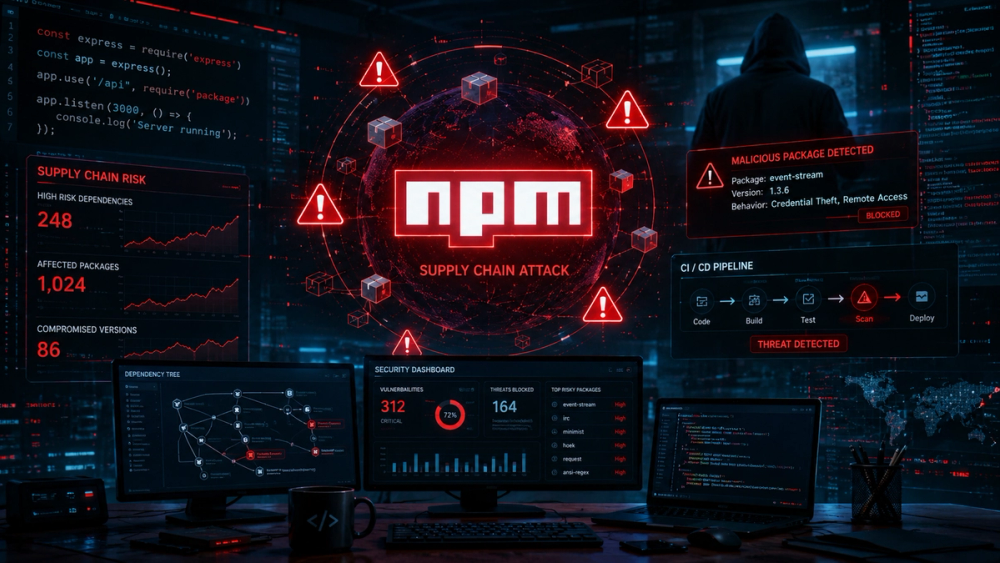
Cyber Security
Cybersecurity in 2026: The npm Supply Chain Crisis Every Developer Should Understand
Jun 11, 2026, 02:29 PM•4 min read• Aditya Sahrawat
Aditya SahrawatCybersecurity in 2026: The npm Supply Chain Crisis Every Developer Should Understand
The npm ecosystem powers millions of applications worldwide, making it one of the most critical components of modern software development. Unfortunately, it has also become one of the most attractive targets for cybercriminals.
Over the past year, attackers have shifted their focus from traditional application vulnerabilities to software supply chain attacks, targeting package maintainers, CI/CD pipelines, and developer environments. Recent incidents demonstrate that a single compromised package can impact thousands of organizations within hours.
Why npm Is a Prime Target
Modern JavaScript applications depend on hundreds or even thousands of third-party packages. Many of these dependencies are automatically installed during builds and deployments.
Attackers know that compromising a trusted package is often easier and more effective than attacking individual companies directly. A malicious update can spread through developer machines, CI/CD pipelines, production environments, and cloud infrastructure almost instantly.
Security researchers and government agencies have warned that attacks involving maintainer account compromise, typosquatting, stolen credentials, and malicious dependency injection are increasing across the npm ecosystem.
The Axios Supply Chain Attack
One of the most significant npm incidents in 2026 involved Axios, one of the world's most widely used JavaScript HTTP libraries.
Attackers gained access to a maintainer account and published malicious versions of Axios that included a hidden dependency designed to install a cross-platform Remote Access Trojan (RAT) on Windows, macOS, and Linux systems. The malicious releases bypassed normal CI/CD publishing workflows and remained available long enough to impact numerous environments before removal.
This attack highlighted a dangerous reality:
Trusting a package is no longer enough. You must verify the entire software supply chain.
The Rise of "Mini Shai-Hulud"
Following the large-scale attacks seen in 2025, a new wave known as "Mini Shai-Hulud" emerged in 2026.
The campaign targeted hundreds of npm packages and developer ecosystems, including projects connected to TanStack and Mistral AI. The malware focused on stealing:
- GitHub tokens
- Cloud credentials
- CI/CD secrets
- Developer environment configurations
Researchers reported rapid propagation across compromised packages, demonstrating how quickly malicious code can spread throughout open-source ecosystems.
Common Attack Techniques
1. Maintainer Account Takeover
Attackers obtain access through phishing, credential theft, or leaked tokens and publish malicious package versions.
2. Dependency Confusion
Malicious packages are uploaded with names similar to internal or trusted packages, tricking build systems into installing them.
3. Typosquatting
Attackers publish packages with names that closely resemble popular libraries.
Examples:
- expresss
- reactt
- nextj
A single typo can introduce malware into production systems.
4. Malicious Post-Install Scripts
Packages execute scripts during installation that:
- Download malware
- Steal environment variables
- Extract secrets
- Establish remote access
5. CI/CD Pipeline Compromise
Modern attacks increasingly target automated deployment pipelines because compromising one build system can impact every downstream application.
How Developers Can Protect Themselves
Enable MFA Everywhere
Mandatory multi-factor authentication for:
- npm accounts
- GitHub accounts
- Cloud providers
Audit Dependencies Continuously
Run:
npm audit
npm outdated
Regularly review:
npm ls
Use Dependency Scanning
Integrate tools such as:
- Dependabot
- Snyk
- Socket.dev
- GuardDog
- Trivy
Research in 2026 shows that combining multiple detection approaches significantly improves malicious package detection rates.
Protect CI/CD Pipelines
- Use short-lived tokens
- Avoid publishing from developer machines
- Implement artifact signing
- Restrict package publishing permissions
Monitor New Dependencies
Every dependency introduces additional attack surface.
Before installing a package:
- Check maintainer history
- Review repository activity
- Inspect install scripts
- Verify package popularity
Rotate Credentials After Suspicious Activity
If a malicious package is detected:
- Assume compromise.
- Rotate all credentials.
- Rebuild systems from trusted sources.
- Audit cloud and GitHub access logs.
Security experts recommended these actions during the Axios incident due to the possibility of credential theft and remote access.
Key Takeaways
The biggest cybersecurity threat facing JavaScript developers today is no longer just vulnerable code—it's compromised trust.
Recent attacks against Axios, TanStack, Mistral AI, and hundreds of npm packages show that attackers are increasingly targeting the software supply chain itself. As organizations continue to rely on open-source ecosystems, securing dependencies, developer accounts, and CI/CD pipelines must become a core part of every security strategy.
Cybersecurity in 2026 is not only about protecting applications. It is about protecting the entire path that software takes from source code to production.