••
← Back to Blog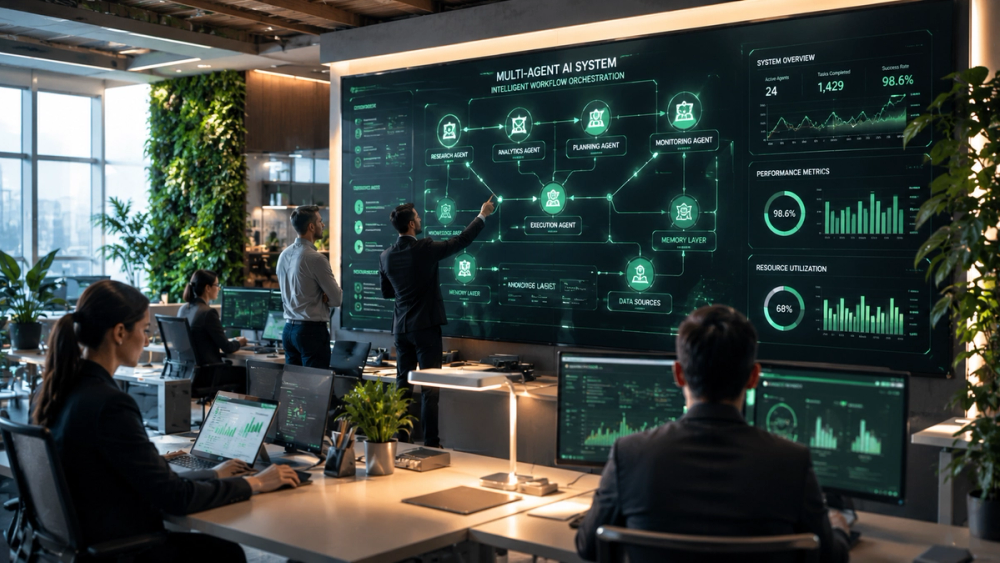
Artificial Intelligence
Enterprise AI
How Enterprises Are Adopting Multi-Agent AI Systems
Jun 18, 2026, 08:35 PM•5 min read• Aditya Sahrawat
Aditya SahrawatHow Enterprises Are Adopting Multi-Agent AI Systems
Artificial Intelligence is rapidly evolving from simple chatbots and standalone copilots into sophisticated ecosystems of collaborating AI agents. As organizations move beyond experimental AI projects, a new architecture is emerging as the foundation for enterprise automation: Multi-Agent AI Systems.
Instead of relying on a single AI model to handle every task, enterprises are deploying networks of specialized AI agents that work together to achieve business objectives. These systems can plan, reason, execute tasks, retrieve information, coordinate workflows, and continuously adapt to changing conditions.
From customer support and software development to supply chain management and financial operations, multi-agent systems are becoming a key component of modern enterprise AI strategies.
What Are Multi-Agent AI Systems?
A Multi-Agent AI System consists of multiple autonomous AI agents that collaborate to solve problems and execute workflows.
Each agent is designed for a specific role, such as:
- Research and information gathering
- Data analysis
- Planning and orchestration
- Decision support
- Task execution
- Quality assurance
- Customer interaction
Rather than forcing a single model to perform every function, enterprises divide complex tasks across specialized agents that communicate and coordinate with one another.
Think of it as building a digital workforce where each AI agent acts like a team member with a defined responsibility.
Why Enterprises Are Moving Beyond Single AI Models
Traditional AI assistants work well for simple interactions, but enterprise workflows often involve:
- Multiple systems and data sources
- Cross-functional approvals
- Complex business rules
- Continuous monitoring
- Long-running processes
A single AI model struggles to manage these responsibilities efficiently.
Multi-agent architectures address these limitations by enabling:
Parallel Execution
Multiple agents can work simultaneously on different parts of a workflow, significantly reducing execution time.
Specialized Expertise
Each agent can be optimized for a specific task, improving accuracy and performance.
Scalability
Organizations can add new agents without redesigning the entire AI infrastructure.
Fault Isolation
If one agent encounters an issue, other agents can continue operating, increasing system resilience.
Enterprise Use Cases Driving Adoption
Customer Support Operations
Modern support platforms are increasingly deploying multiple AI agents to manage customer interactions.
Typical workflow:
- Intent Detection Agent identifies customer requests.
- Knowledge Agent retrieves relevant information.
- Resolution Agent generates solutions.
- Escalation Agent routes complex issues to humans.
- Quality Agent reviews responses before delivery.
This approach reduces response times while maintaining service quality.
Software Development
Engineering teams are among the earliest adopters of multi-agent systems.
Organizations use specialized agents for:
- Requirement analysis
- Code generation
- Code review
- Security scanning
- Testing
- Documentation
Development workflows that previously required multiple engineers can now be accelerated through coordinated AI collaboration.
Financial Services
Banks and financial institutions use multi-agent architectures for:
- Fraud detection
- Risk assessment
- Regulatory compliance
- Portfolio analysis
- Customer onboarding
Different agents monitor transactions, analyze anomalies, validate compliance requirements, and generate recommendations in real time.
Supply Chain Management
Multi-agent systems help enterprises optimize supply chain operations through:
- Demand forecasting
- Inventory monitoring
- Logistics coordination
- Vendor management
- Risk prediction
By continuously exchanging information, AI agents can identify disruptions and recommend corrective actions before problems escalate.
The Core Architecture of Enterprise Multi-Agent Systems
A typical enterprise implementation includes several layers.
Orchestration Layer
Acts as the central coordinator responsible for:
- Task distribution
- Agent communication
- Workflow management
- Resource allocation
Specialized Agent Layer
Contains agents dedicated to specific functions such as:
- Research
- Analytics
- Customer interaction
- Data processing
- Execution
Knowledge Layer
Provides access to:
- Enterprise databases
- Internal documentation
- APIs
- Knowledge graphs
- Vector databases
Governance Layer
Ensures compliance with:
- Security policies
- Access controls
- Audit requirements
- Regulatory frameworks
This governance component is becoming increasingly important as enterprises scale AI deployments.
Key Benefits Enterprises Are Realizing
Faster Decision-Making
Multiple agents can analyze information simultaneously, reducing delays and improving responsiveness.
Improved Productivity
Routine tasks can be automated across departments, allowing employees to focus on higher-value work.
Enhanced Accuracy
Specialized agents often outperform general-purpose systems in domain-specific tasks.
Operational Efficiency
Organizations can automate end-to-end workflows instead of isolated tasks.
Greater Business Agility
New capabilities can be added by introducing additional agents without rebuilding existing systems.
Challenges Enterprises Must Address
While adoption is accelerating, several challenges remain.
Governance and Oversight
Organizations must establish clear accountability for AI-generated actions and decisions.
Security Risks
Multi-agent systems often interact with sensitive enterprise data and critical business processes.
Agent Coordination
Ensuring agents communicate effectively without conflicts requires sophisticated orchestration.
Cost Management
Running multiple AI models simultaneously can increase infrastructure and operational expenses.
Observability
Enterprises need visibility into agent behavior, decision paths, and workflow outcomes.
As a result, AI Operations (AIOps) and AI Governance frameworks are becoming essential components of successful deployments.
The Role of Agentic AI Platforms
Technology vendors are rapidly introducing platforms designed specifically for agent orchestration.
These platforms provide:
- Agent management
- Workflow orchestration
- Tool integration
- Memory systems
- Monitoring dashboards
- Security controls
As the ecosystem matures, enterprises are increasingly adopting standardized frameworks instead of building everything from scratch.
What the Future Looks Like
The next phase of enterprise AI will likely be defined by networks of intelligent agents collaborating across business functions.
Future systems may include:
- Autonomous business process execution
- Self-improving workflows
- Cross-department AI collaboration
- Real-time enterprise decision-making
- AI-powered digital workforces
Organizations that successfully implement multi-agent architectures today will be better positioned to scale AI adoption across the enterprise tomorrow.
Conclusion
Multi-Agent AI Systems represent a major shift in how enterprises deploy and scale artificial intelligence. By combining specialized agents, orchestration frameworks, governance controls, and enterprise data sources, organizations can automate increasingly complex workflows while improving efficiency, accuracy, and agility.
As businesses move from AI experimentation to enterprise-wide implementation, multi-agent architectures are quickly becoming the foundation of the next generation of intelligent operations.