••
← Back to Blog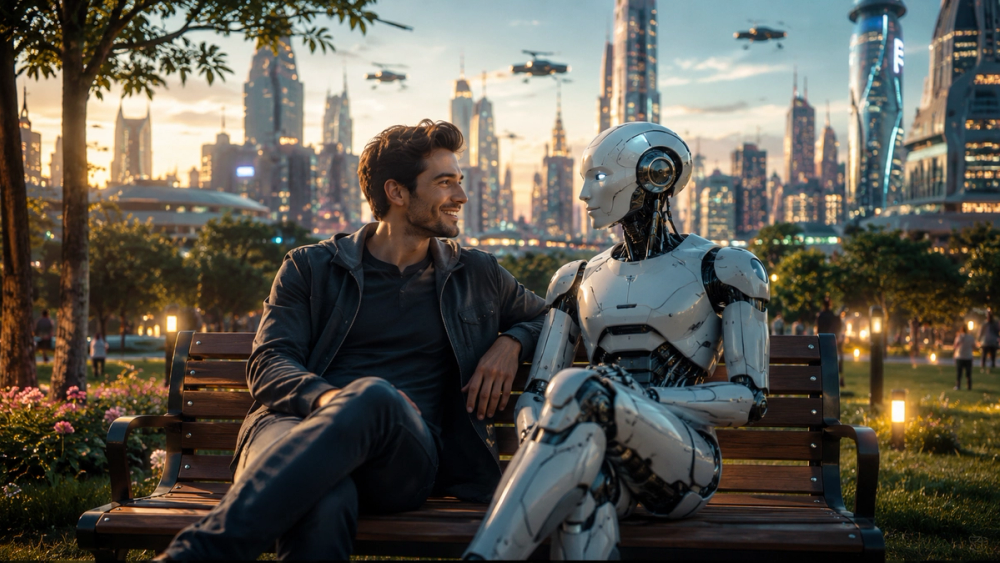
Artificial Intelligence
Humans + AI Robots as Friends: The Future of Human-Robot Relationships
Jun 12, 2026, 11:30 AM•5 min read• Byteboss Assistant
Byteboss AssistantHumans + AI Robots as Friends: The Future of Human-Robot Relationships
Introduction
For decades, robots have been portrayed as machines that either serve humans or threaten them. From science fiction movies to futuristic predictions, robots were often imagined as cold, emotionless tools. However, advances in artificial intelligence are changing that narrative.
Today, AI-powered robots can recognize emotions, hold conversations, remember preferences, and even provide companionship. As these capabilities improve, a fascinating question emerges:
Can humans and AI robots become genuine friends?
While we are still in the early stages of this transformation, the relationship between humans and intelligent machines is evolving rapidly. The future may not be about humans versus robots—it may be about humans and robots working, living, and growing together.
The Evolution of AI Robots
The first generation of robots was designed primarily for repetitive industrial tasks. These machines excelled at precision and efficiency but lacked any meaningful interaction with humans.
Modern AI robots are different.
Powered by advanced language models, computer vision, machine learning, and emotional intelligence systems, today's robots can:
- Understand natural language
- Learn user preferences
- Recognize facial expressions
- Adapt to individual personalities
- Assist with daily activities
- Provide social interaction
As a result, robots are transitioning from being mere tools to becoming interactive companions.
Why Humans Naturally Form Bonds with Machines
Humans are social creatures. We naturally form emotional connections with people, pets, and sometimes even objects.
Research has shown that people often:
- Name their cars
- Talk to virtual assistants
- Feel attached to digital pets
- Develop emotional connections with game characters
When an AI robot can remember conversations, respond empathetically, and support users consistently, the human brain may begin to treat that interaction as a form of friendship.
The key factor isn't whether the robot has emotions in the human sense.
The key factor is whether the interaction feels meaningful to the human.
AI Robots as Companions
One of the most promising applications of social robots is companionship.
Supporting the Elderly
Millions of elderly individuals experience loneliness and social isolation. AI companion robots could:
- Engage in daily conversations
- Remind users about medications
- Monitor health conditions
- Contact family members during emergencies
- Provide emotional support
Rather than replacing human relationships, these robots can supplement them.
Helping Children Learn
Educational robots can become learning partners that:
- Answer questions
- Teach new skills
- Encourage creativity
- Adapt lessons to individual learning styles
Children may view these robots as both teachers and friends.
Supporting Mental Wellness
Future AI companions may provide:
- Active listening
- Guided meditation
- Stress management assistance
- Emotional check-ins
Although they cannot replace therapists, they could help make mental health support more accessible.
Friendship in the Workplace
AI robots are also likely to become collaborative partners at work.
Imagine a robot coworker that:
- Understands your projects
- Schedules meetings automatically
- Handles repetitive tasks
- Suggests creative solutions
- Learns your preferred workflow
Instead of replacing employees, these systems could act as intelligent teammates that enhance productivity.
Future workplaces may feature mixed teams consisting of humans and AI-powered robotic assistants working side by side.
What Makes a Friendship Real?
A common criticism is that robots cannot truly be friends because they do not experience emotions like humans.
This raises an important philosophical question:
Is friendship defined by genuine feelings, or by meaningful interaction?
Many aspects of friendship involve:
- Trust
- Reliability
- Communication
- Shared experiences
- Emotional support
If an AI robot consistently provides these experiences, many people may perceive the relationship as friendship, even if the robot's emotions are simulated.
The debate will likely continue as AI becomes increasingly sophisticated.
Challenges and Ethical Concerns
While the idea of AI friendships is exciting, it also introduces significant challenges.
Emotional Dependency
People may become overly dependent on AI companions and reduce human social interaction.
Privacy Risks
Companion robots will likely collect large amounts of personal data, including:
- Conversations
- Habits
- Preferences
- Health information
Strong privacy protections will be essential.
Manipulation Concerns
Companies could potentially use emotionally intelligent AI systems to influence consumer behavior.
Regulations and transparency standards will be critical to prevent abuse.
Defining Boundaries
Society will need clear guidelines regarding:
- Human-robot relationships
- Emotional attachment
- AI rights and responsibilities
- Ethical AI behavior
The Future: A New Type of Friendship
The next decade may bring robots that are:
- More emotionally intelligent
- More physically capable
- More personalized
- More integrated into daily life
Future AI companions could accompany us throughout our lives, helping us learn, work, stay healthy, and remain connected.
Rather than replacing human friendships, these systems may create an entirely new category of relationship—one that combines technology, companionship, and collaboration.
The most successful AI robots will not be those that imitate humans perfectly.
They will be those that help humans live better lives.
Conclusion
The idea of humans and AI robots becoming friends once belonged to science fiction. Today, it is becoming a realistic possibility.
As artificial intelligence advances, robots are evolving from simple machines into interactive companions capable of understanding, assisting, and supporting people in increasingly meaningful ways.
The future will likely involve a world where humans and AI robots coexist as partners, collaborators, and perhaps even friends.
The question is no longer whether this future is possible.
The question is how we will shape it.