••
← Back to Blog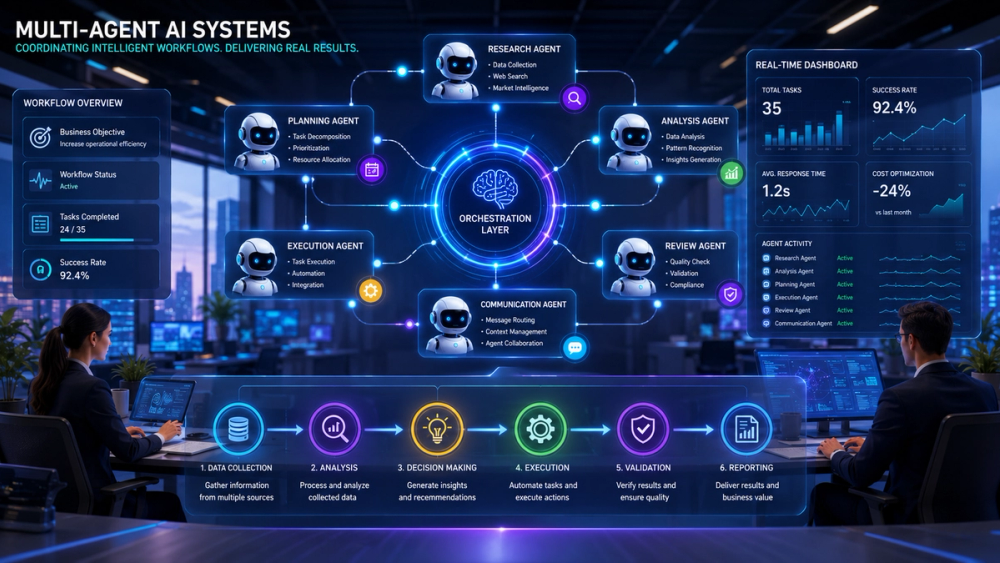
Artificial Intelligence
Multi-Agent Systems & AI Workflows: The Future of Autonomous Business Automation
Jun 16, 2026, 03:45 PM•4 min read• Aditya Sahrawat
Aditya SahrawatIntroduction
Artificial Intelligence is evolving beyond single-purpose chatbots and assistants. Organizations are now adopting Multi-Agent Systems (MAS) and AI Workflows to automate complex business processes, coordinate tasks, and solve problems that require multiple specialized AI agents working together.
Instead of relying on one AI model to handle everything, businesses are deploying networks of intelligent agents that collaborate, communicate, and execute workflows autonomously. This shift is enabling companies to build scalable AI ecosystems capable of handling research, analysis, customer support, software development, and operational decision-making.
In this article, we'll explore what Multi-Agent Systems are, how AI workflows function, and why they represent the next frontier of enterprise automation.
What Are Multi-Agent Systems?
A Multi-Agent System consists of multiple AI agents that work together to achieve a common goal. Each agent is designed for a specific responsibility and can communicate with other agents to complete larger tasks.
For example:
- Research Agent gathers information
- Analysis Agent processes findings
- Writing Agent creates reports
- Review Agent validates output
- Execution Agent performs actions
Together, these agents create a collaborative intelligence network that mimics how human teams operate.
Understanding AI Workflows
AI workflows define the sequence of actions, decisions, and interactions required to complete a task.
A typical AI workflow includes:
- Data Collection
- Data Processing
- Decision Making
- Task Execution
- Monitoring & Feedback
By combining structured workflows with intelligent agents, organizations can automate end-to-end business operations with minimal human intervention.
Why Multi-Agent Systems Matter
1. Scalability
Single AI models often struggle when handling multiple responsibilities simultaneously.
Multi-Agent Systems distribute workloads across specialized agents, enabling:
- Faster execution
- Better resource utilization
- Improved system reliability
2. Higher Accuracy
Specialized agents focus on specific tasks, leading to better outputs than general-purpose AI systems.
Examples include:
- Dedicated coding agents
- Research agents
- Compliance agents
- Customer support agents
3. Continuous Collaboration
Agents can share context, validate results, and refine outputs collaboratively.
This reduces:
- Hallucinations
- Inconsistent responses
- Operational errors
Core Components of an AI Workflow
Agent Layer
Responsible for task execution.
Examples:
- Planning Agents
- Research Agents
- Coding Agents
- QA Agents
Memory Layer
Stores:
- Historical interactions
- Business knowledge
- User preferences
This enables agents to make context-aware decisions.
Orchestration Layer
Coordinates communication between agents and manages workflow execution.
Popular orchestration frameworks include:
- LangGraph
- CrewAI
- AutoGen
- Semantic Kernel
Tool Layer
Provides access to:
- Databases
- APIs
- Search Engines
- Internal Systems
Agents leverage these tools to perform real-world actions.
Real-World Use Cases
Customer Support Automation
A support workflow might involve:
- Ticket Classification Agent
- Knowledge Retrieval Agent
- Response Generation Agent
- Quality Assurance Agent
This enables rapid, accurate customer support at scale.
Software Development
AI development teams are increasingly deploying:
- Planning Agents
- Coding Agents
- Testing Agents
- Documentation Agents
These systems can accelerate development cycles while maintaining code quality.
Marketing Automation
Marketing workflows can automate:
- Keyword Research
- Content Creation
- SEO Optimization
- Social Media Distribution
- Performance Analysis
Resulting in faster campaign execution and better ROI.
Financial Operations
Financial institutions use agent-based workflows for:
- Fraud Detection
- Risk Analysis
- Compliance Monitoring
- Portfolio Management
Improving both efficiency and accuracy.
Challenges of Multi-Agent Systems
Despite their advantages, Multi-Agent Systems face several challenges:
Communication Overhead
More agents create additional communication requirements.
Cost Management
Running multiple AI agents can increase infrastructure expenses.
Security & Governance
Organizations must ensure:
- Data privacy
- Access control
- Auditability
Workflow Complexity
Poorly designed workflows can create bottlenecks and inefficiencies.
Proper orchestration is essential for success.
Best Practices for Building AI Workflows
Define Clear Agent Roles
Avoid overlapping responsibilities.
Implement Shared Memory
Enable agents to access consistent information.
Use Human-in-the-Loop Validation
Critical decisions should include human oversight.
Monitor Agent Performance
Track:
- Accuracy
- Latency
- Cost
- Reliability
Start Small and Scale
Begin with simple workflows before expanding into enterprise-wide automation.
The Future of Agentic AI
The rise of Agentic AI is transforming how organizations approach automation.
Future systems will feature:
- Autonomous decision-making
- Self-improving workflows
- Cross-agent collaboration
- Real-time adaptation
- Enterprise-wide orchestration
As AI models become more capable and orchestration frameworks mature, Multi-Agent Systems will become foundational infrastructure for modern businesses.
Conclusion
Multi-Agent Systems and AI workflows represent a significant leap forward in intelligent automation. By combining specialized AI agents with structured workflows, organizations can automate complex operations, improve decision-making, and achieve unprecedented levels of efficiency.
Businesses that invest in agent-based architectures today will be better positioned to scale AI initiatives, reduce operational costs, and gain a competitive advantage in the rapidly evolving AI landscape.