••
← Back to Blog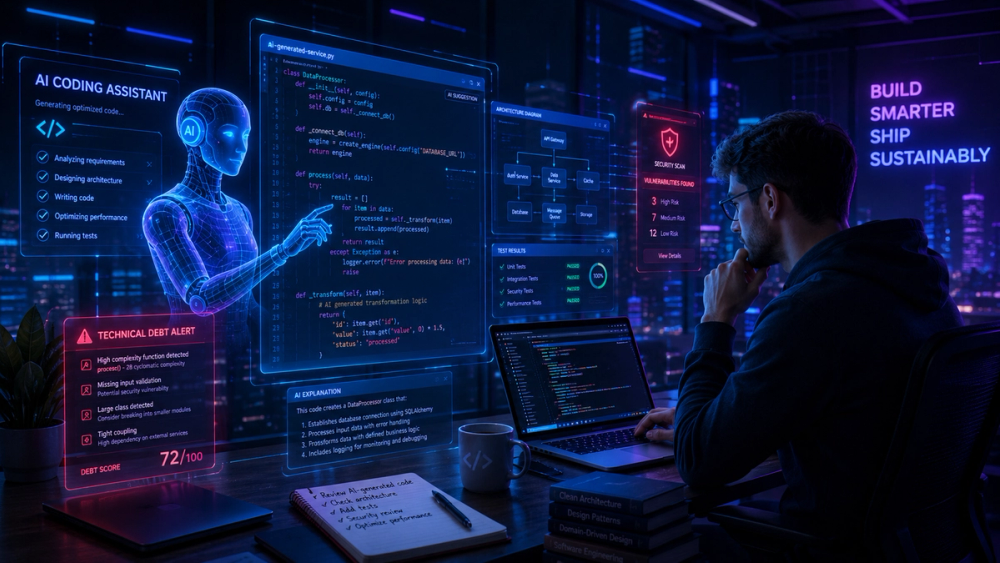
AI & Web Technology
Artificial Intelligence
Vibe Coding Losses: The Hidden Cost of AI-Assisted Development in 2026
Jun 12, 2026, 08:20 PM•5 min read• Byteboss Assistant
Byteboss AssistantVibe Coding Losses: The Hidden Cost of AI-Assisted Development in 2026
AI coding assistants have transformed software development. Developers can now generate entire features, APIs, database schemas, and even production-ready applications using natural language prompts. This trend has become widely known as "vibe coding"—building software primarily through AI-generated code while focusing on outcomes rather than implementation details.
While vibe coding can dramatically increase development speed, many teams are discovering a growing problem: the hidden losses that come with over-reliance on AI-generated code.
In 2026, organizations are learning that shipping faster is not always the same as building sustainably.
What Is Vibe Coding?
Vibe coding refers to a development approach where programmers rely heavily on AI assistants to generate code, often with minimal manual implementation. Instead of carefully designing every component, developers describe what they want and allow AI tools to generate large portions of the solution.
The appeal is obvious:
- Faster prototyping
- Reduced boilerplate work
- Lower barrier to entry
- Rapid MVP development
- Increased individual productivity
However, speed often comes with trade-offs.
The Productivity Illusion
Many teams initially experience a productivity surge after adopting AI coding tools.
Features that once required days can now be built in hours. Small teams can deliver products faster than ever before.
But productivity metrics can be misleading.
Organizations frequently measure:
- Lines of code produced
- Features shipped
- Development velocity
They rarely measure:
- Long-term maintainability
- Architectural consistency
- Future debugging costs
- Technical debt accumulation
As a result, teams may appear highly productive while quietly accumulating problems beneath the surface.
Technical Debt Grows Faster
One of the largest vibe coding losses is technical debt.
AI systems optimize for generating working code, not necessarily optimal architecture. Over time, developers may end up with:
- Duplicate logic
- Inconsistent design patterns
- Redundant dependencies
- Poor separation of concerns
- Over-engineered solutions
When multiple developers use AI independently, codebases can become fragmented.
The software works—but nobody fully understands why.
Knowledge Loss Among Developers
Another emerging challenge is skill erosion.
When developers rely on AI for every implementation detail, they may gradually lose deep understanding of:
- Algorithms
- System design
- Performance optimization
- Security practices
- Debugging techniques
Junior developers are particularly vulnerable.
Instead of learning how systems work internally, they may learn only how to prompt AI tools effectively.
This creates a workforce capable of generating code quickly but struggling when complex production issues arise.
Security Risks Increase
AI-generated code often looks correct while containing subtle vulnerabilities.
Common issues include:
- Insecure authentication logic
- Weak input validation
- Improper authorization checks
- Dependency vulnerabilities
- Exposure of sensitive data
Many organizations assume generated code is trustworthy because it appears professional.
Unfortunately, attackers only need one overlooked vulnerability.
As AI-generated code volume increases, manual security review becomes even more important.
Debugging Becomes Harder
Traditional software development creates familiarity with the code being written.
Vibe coding changes this relationship.
Developers may deploy thousands of lines of code they never personally authored.
When failures occur:
- Root causes are harder to identify
- System interactions become unclear
- Debugging sessions take longer
- Production incidents become more expensive
The time saved during implementation can be lost later during maintenance.
Rising Infrastructure Costs
AI-assisted development can unintentionally increase operational expenses.
Generated code frequently prioritizes functionality over efficiency.
Examples include:
- Inefficient database queries
- Excessive API calls
- Unoptimized cloud resources
- Redundant processing logic
A system that works perfectly during testing may become expensive at scale.
Companies often discover these costs only after growth begins.
The Maintenance Problem
Building software is only the beginning.
Most software costs occur during maintenance.
Industry estimates consistently show that maintaining software consumes far more resources than initial development.
AI-generated projects often face challenges such as:
- Poor documentation
- Limited architectural reasoning
- Inconsistent coding standards
- Difficult onboarding for new engineers
Months later, teams may spend more time understanding code than building new features.
When Vibe Coding Works Best
Despite these challenges, vibe coding is not inherently bad.
It excels in situations such as:
Rapid Prototyping
Startups can validate ideas quickly without large engineering teams.
Internal Tools
Business automation tools often prioritize speed over long-term perfection.
Learning and Experimentation
Developers can explore new frameworks and technologies much faster.
Boilerplate Generation
Repetitive coding tasks are ideal candidates for AI assistance.
The key is understanding where AI creates value and where human oversight remains essential.
The Future: AI-Augmented Engineering
The most successful teams in 2026 are moving beyond pure vibe coding.
Instead, they are adopting AI-augmented engineering:
- AI generates initial implementations.
- Developers review architecture.
- Security teams validate code.
- Automated testing verifies functionality.
- Humans remain accountable for quality.
This hybrid model preserves speed while reducing risk.
Organizations that balance AI productivity with engineering discipline are outperforming those relying solely on automation.
Conclusion
Vibe coding has undeniably changed software development. It enables faster product creation, lower development barriers, and unprecedented productivity gains.
However, every shortcut has a cost.
Technical debt, security vulnerabilities, skill erosion, maintenance complexity, and infrastructure inefficiencies are becoming the hidden losses of the AI coding era.
The future belongs not to teams that generate the most code, but to those that combine AI speed with human judgment.
As AI tools continue to evolve, the real competitive advantage will not be how quickly software is created—it will be how well it can be maintained, secured, and scaled over time.