••
← Back to Blog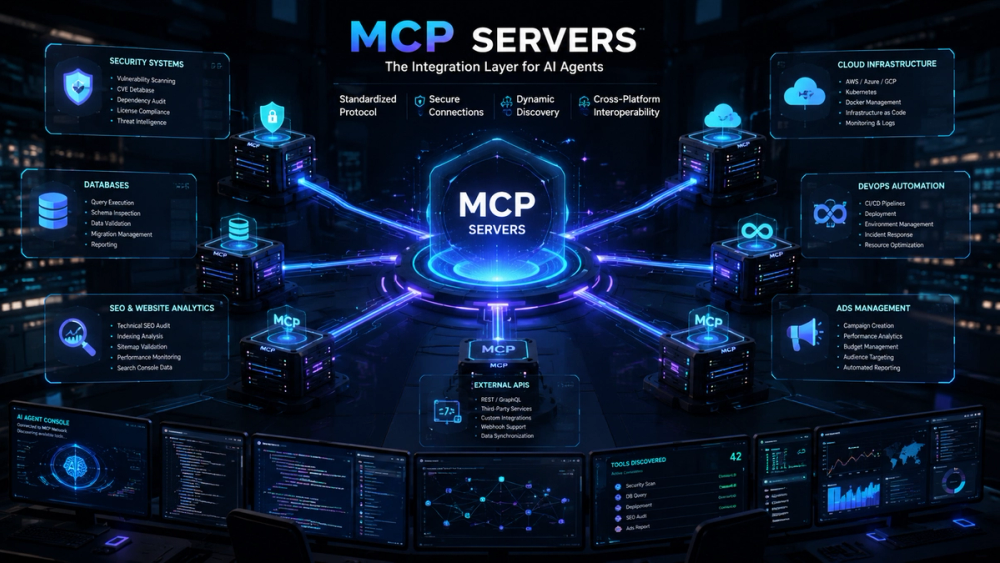
Artificial Intelligence
What Are MCP Servers? The Future of AI Tool Integration in 2026
Jun 11, 2026, 04:54 PM•4 min read• Aditya Sahrawat
Aditya SahrawatWhat Are MCP Servers?
AI agents are becoming increasingly capable, but intelligence alone isn't enough.
To perform useful work, AI models need access to external systems such as databases, APIs, cloud platforms, file systems, and business applications.
This is where Model Context Protocol (MCP) comes in.
MCP is an open protocol designed to standardize how AI models communicate with tools and external resources. Instead of creating custom integrations for every AI application, developers can expose functionality through MCP servers that any compatible AI client can use.
Think of MCP servers as the API layer for AI agents.
Why MCP Servers Matter
Before MCP, connecting AI models to tools often required:
- Custom API integrations
- Framework-specific implementations
- Repetitive tool definitions
- Vendor lock-in
- Complex maintenance
MCP solves these challenges by providing a common protocol that AI clients can understand.
Benefits include:
✅ Standardized tool communication
✅ Reusable integrations
✅ Faster AI development
✅ Better interoperability
✅ Reduced maintenance overhead
How MCP Servers Work
An MCP server exposes resources and capabilities that AI clients can access.
A typical workflow looks like this:
- AI client connects to an MCP server
- Server advertises available tools
- AI discovers capabilities dynamically
- User requests an action
- AI invokes the appropriate tool
- MCP server executes the operation
- Results are returned to the AI
This architecture allows AI agents to interact with real-world systems safely and efficiently.
Common MCP Server Use Cases
1. Security Auditing
Security-focused MCP servers can provide:
- Dependency auditing
- CVE lookups
- Package reputation analysis
- License compliance checks
- Supply chain attack detection
An AI Security Engineer can use these tools to automatically analyze projects and identify risks.
2. DevOps Automation
MCP servers can expose:
- Kubernetes operations
- Docker management
- CI/CD workflows
- Cloud infrastructure controls
- Monitoring systems
This enables AI agents to assist with deployment, troubleshooting, and operational tasks.
3. SEO and Website Analysis
MCP servers are increasingly used for:
- Technical SEO audits
- Indexing diagnostics
- Search Console analysis
- Sitemap validation
- Performance monitoring
AI can perform comprehensive website reviews without requiring custom integrations.
4. Database Operations
Database MCP servers can provide:
- Query execution
- Schema inspection
- Migration management
- Data validation
- Reporting capabilities
This allows AI assistants to interact with databases while maintaining controlled access.
5. Advertising Management
An Ads Manager MCP server can help AI agents:
- Create campaigns
- Analyze performance
- Manage budgets
- Generate reports
- Optimize targeting strategies
This reduces manual effort for marketing teams.
Why Developers Are Building MCP Servers
The rise of agentic AI has created demand for standardized integrations.
Developers are building MCP servers because they:
- Extend AI capabilities
- Enable automation
- Improve developer productivity
- Simplify integrations
- Create reusable infrastructure
Instead of writing tool integrations repeatedly, developers can build once and reuse across multiple AI applications.
MCP Server Ideas for Developers
If you're building a portfolio in 2026, consider creating:
Security Audit MCP
Features:
- NPM package auditing
- CVE intelligence
- Dependency risk scoring
- License compliance
- Supply chain analysis
AI Security Engineer MCP
Features:
- Threat modeling
- Vulnerability analysis
- Secure coding reviews
- Security recommendations
- Compliance reporting
SEO Audit MCP
Features:
- Technical SEO checks
- Crawl diagnostics
- Indexing analysis
- Metadata validation
- Performance insights
Ads Manager MCP
Features:
- Campaign generation
- Performance reporting
- Budget optimization
- Audience analysis
- Automated recommendations
DevOps Engineer MCP
Features:
- Deployment automation
- Infrastructure monitoring
- Incident investigation
- Log analysis
- Resource optimization
The Future of MCP
As AI agents become more autonomous, MCP servers are likely to become a core part of modern software architecture.
Organizations will increasingly expose their internal systems through MCP, allowing AI assistants to:
- Access business data
- Automate workflows
- Execute operational tasks
- Generate insights
- Improve productivity
The companies that embrace standardized AI integrations today will be better positioned for the next wave of AI-powered automation.
Conclusion
MCP servers are transforming how AI systems interact with the real world.
By providing a standardized protocol for tools and resources, they make AI agents more capable, scalable, and maintainable.
Whether you're building security tools, DevOps automation, SEO platforms, or business workflows, MCP servers offer a powerful foundation for the future of AI engineering.