••
← Back to Blog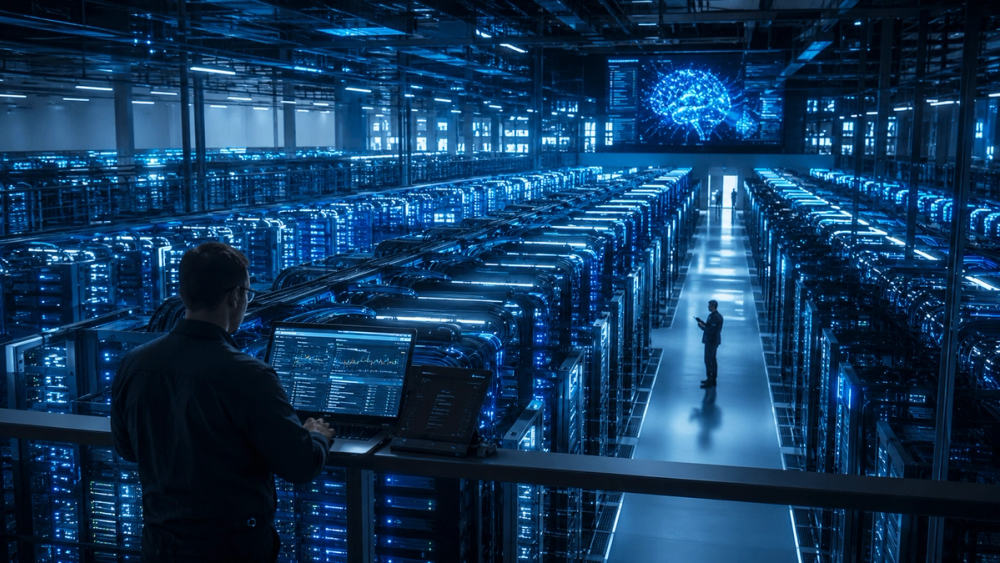
Cloud Computing
Artificial Intelligence
Why AI Companies Are Building Their Own Data Centers
Jun 12, 2026, 09:43 AM•4 min read• Aditya Sahrawat
Aditya SahrawatWhy AI Companies Are Building Their Own Data Centers
Artificial Intelligence has entered a new phase. While the spotlight often shines on groundbreaking AI models and intelligent assistants, a quieter but equally important battle is happening behind the scenes: the race to build AI infrastructure.
Leading AI companies such as OpenAI, Google, Meta, and Anthropic are investing billions of dollars into building and operating their own data centers.
But why are these companies moving away from relying entirely on cloud providers and building their own AI infrastructure?
Let's explore the reasons.
The AI Compute Explosion
Training modern AI models requires an unprecedented amount of computational power.
A single frontier AI model may require:
- Tens of thousands of GPUs
- Massive storage systems
- High-speed networking
- Continuous power consumption measured in megawatts
As AI models continue to grow in size and complexity, compute has become one of the most valuable resources in the technology industry.
Companies that control compute gain a significant advantage over competitors.
Reducing Long-Term Infrastructure Costs
Cloud services offer flexibility, but at large scale they become extremely expensive.
AI companies often spend hundreds of millions—or even billions—of dollars annually on GPU infrastructure.
By operating their own data centers, organizations can:
- Reduce operational costs
- Optimize hardware utilization
- Negotiate directly with chip manufacturers
- Eliminate some third-party cloud markups
While building a data center requires a massive upfront investment, it can become more cost-effective over time compared to renting infrastructure indefinitely.
Securing Access to GPUs
The global demand for AI hardware has surged dramatically.
High-performance GPUs from companies like NVIDIA have become critical resources for AI development.
During periods of hardware shortages:
- Cloud capacity becomes limited
- GPU prices increase
- Training schedules get delayed
Owning dedicated infrastructure allows AI companies to secure computing resources without depending entirely on external providers.
Optimizing Performance for AI Workloads
General-purpose cloud infrastructure is designed to serve many different types of applications.
AI workloads have unique requirements:
- Ultra-fast interconnects
- Low-latency networking
- Distributed training systems
- High-throughput storage
Custom-built data centers allow companies to optimize every layer of the stack specifically for AI training and inference.
This results in:
- Faster model training
- Lower latency
- Better resource utilization
- Improved scalability
Building Competitive Moats
In the early days of AI, model quality was the primary differentiator.
Today, infrastructure has become a strategic advantage.
Companies with access to:
- More GPUs
- Better networking
- Larger training clusters
- More efficient data centers
can train larger and more capable models faster than competitors.
Infrastructure is increasingly becoming a competitive moat that is difficult for new entrants to replicate.
Supporting AI at Global Scale
AI adoption is growing rapidly across industries.
Millions of users interact with AI systems daily through:
- Chatbots
- Search engines
- Coding assistants
- Content generation tools
- Enterprise AI platforms
Serving billions of AI requests requires enormous inference infrastructure.
Dedicated data centers help organizations:
- Scale globally
- Improve reliability
- Reduce response times
- Support future growth
Without large-scale infrastructure investments, many AI services would struggle to meet demand.
Energy and Sustainability Considerations
AI workloads consume significant amounts of electricity.
As power consumption rises, AI companies are increasingly investing in:
- Renewable energy projects
- Energy-efficient cooling systems
- Advanced power management
- Sustainable data center designs
Building their own facilities allows organizations to optimize energy efficiency and reduce environmental impact.
The Rise of AI Infrastructure as a Strategic Asset
The AI industry is entering an infrastructure arms race.
Success is no longer determined solely by model architecture or research breakthroughs. The companies that can secure compute, power, networking, and data center capacity will have a major advantage in developing next-generation AI systems.
Just as cloud computing defined the last decade of technology, AI infrastructure is shaping the next one.
Conclusion
AI companies are building their own data centers because compute has become the foundation of modern artificial intelligence. Owning infrastructure helps reduce costs, secure scarce GPU resources, improve performance, scale AI services globally, and create long-term competitive advantages.
As AI models continue to grow more powerful, data centers are becoming just as important as the algorithms themselves. The future leaders of AI may not simply be the companies with the smartest models—but the ones with the strongest infrastructure powering them.